
The intellectual foundations of the American Founding — and, therefore, of the Freedom Conservatism that seeks to preserve its legacy and apply its timeless principles to today’s problems — draw from such sources as the Bible, classical philosophy, classical republicanism, and the English tradition of self-government.
“Seeking for the roots of order,” wrote Russell Kirk in his influential work The Roots of American Order, “we are led to four cities: Jerusalem, Athens, Rome, and London.”
We FreeCons are deeply indebted to Kirk and glean many insights from him, but in this case we feel compelled to amend his list. At least one other city deserves to be on it: Edinburgh.
This city was at the heart of the Scottish Enlightenment of the 18th and early 19th centuries. Its leading figures helped shape the arts, sciences, and economic transformation of the West. “The University of Edinburgh possessed a set of truly great men,” wrote Benjamin Franklin, “as have ever appeared in any age or country.”
Today we spotlight FreeCons who explore the influence of Adam Smith, David Hume, Francis Hutcheson, and other path-breaking thinkers of the Scottish Enlightenment and how their ideas remain relevant to modern politics and policy.
Lessons for our time
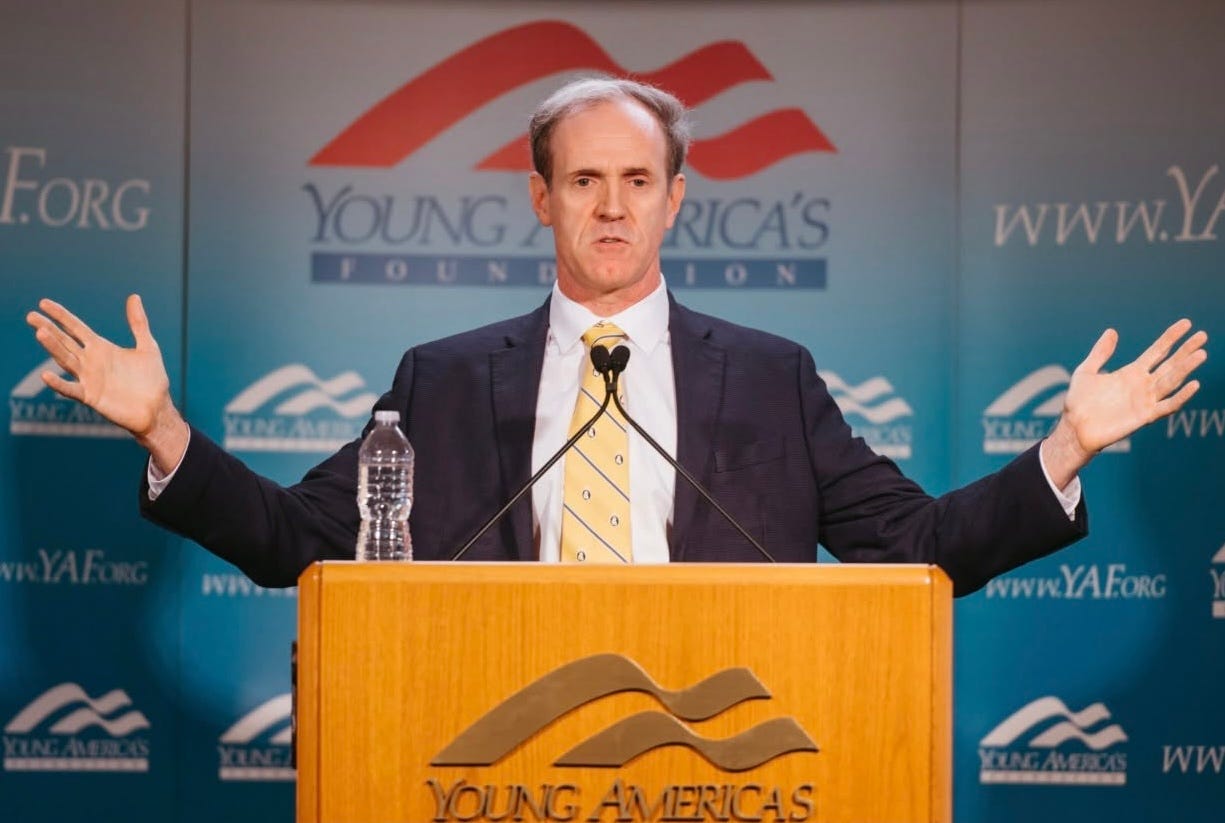
Samuel Gregg serves as president and Friedrich Hayek Chair in Economics and Economic History at the American Institute for Economic Research. He is also a FreeCon signatory.
In a recent essay for Law & Liberty, Gregg described the influence of Adam Smith, Francis Hutcheson, and other thinkers of the Scottish Enlightenment on the American Founding and the broader tradition of ordered liberty.
Scottish philosophers of the 18th century “inherited some formidable pre-Enlightenment intellectual foundations,” Gregg wrote, nothing that medieval and early modern Scotland “may have been an economic and political backwater” but “punched far above its weight in the realm of higher learning.”
Schooled in the ancients, the scholastics, and the likes of René Descartes, Francis Bacon, John Locke, and Isaac Newton, the thinkers of the Scottish Enlightenment turned their scholarly attention to such matters as “literature, philosophy, history, religion, and the relationship between economic development and political change.”
“Scottish Enlightenment thinkers did not agree about everything,” Gregg continued, “They believed, moreover, that improvement (a classic Enlightenment motif) necessitated thinking with and critiquing others. This points to another element that accounts for Scotland’s Enlightenment: the high moral premium that became attached to an atmosphere of relative toleration.”
Their accomplishments remind us, he concluded, that “despite unpromising political and economic circumstances, it is possible for long-standing intellectual traditions combined with institutional reform, openness to new forms of knowledge, and twin commitments to tolerance and substantive debate to generate remarkable improvements that reflect both continuity and innovation. Therein may lie lessons for our time.”
Denying common sense

Ryan Streeter is executive director of the University of Texas at Austin’s Civitas Institute, former director of domestic policy studies at the American Enterprise Institute, and a FreeCon signatory.
In a recent piece for The Wall Street Journal, he posed a provocative question: can Dave Hume save the Democratic Party?
The influential thinker of the Scottish Enlightenment famously distinguished between principle and interest as a driving force for political faction. “Democrats’ intramural struggle with socialism is only the latest evidence that they are morphing from a party from interest into a party from principle,” Streeter wrote.
“Coalitions consisting of organized labor, minority populations, immigrants, farmers and urban machines have given way to a party dominated by highly educated people driven by superstitions and enthusiasms about race, sex and class.”
The Democratic Party’s socialism problem “didn’t appear in a vacuum,” Streeter continued. “Its path was paved by elites who insisted on denying common sense and imposing esoteric ideas — ‘defund the police,’ ‘all white people are racist,’ ‘men can become pregnant’ and so forth.
“Candidates are backing away from some of them, but that is merely an electoral strategy. As Joe Biden’s presidency demonstrated, Democrats who run as moderates don’t end up relenting on culture wars.”
Same bad arguments

Jon Murphy is an assistant professor of economics at Louisiana’s Nicholls State University, a research fellow at the Independent Institute, and a FreeCon signatory.
In a recent piece for the Liberty Fund’s EconLog, Murphy explained Adam Smith’s case for free trade and supplied new information to reinforce its prediction that protectionist policies are required to keep workers from being unsettled, victimized, and shafted by foreign competitors.
He drew two insights from decades of employment data, including a measure of “job security” that consists of initial weekly jobless claims as a percentage of the total employed population.
“First, from the 1980s to the present (with recessions excluded) the average percentage has been trending downward — suggesting that American workers are generally becoming more secure in their jobs,” wrote Murphy. “Even in the 2008 recession, the percentage was lower than during recessions in the 1970s and 80s.
“Second, major international trade deals, such as NAFTA (1994) and China joining the WTO (2000) did not affect job security levels in the aggregate. The general downward trend that starts in the 1980s is uninterrupted (except for recessions).
“If these trade deals really led to the devastation of American workers, as asserted by protectionists, we should expect to see some indication of that devastation in the data. But we do not. The increases we do see are tied to recessions, not trade policies.”
After answering several potential rejoinders from protectionists, Murphy circled back to where he started. “To refute every argument against international trade would require a book,” he concluded. “Adam Smith’s Wealth of Nations is a good starting point; he refuted protectionist arguments of his day, and protectionist arguments have not changed since the 1700s.”
In the mix
• At National Review, FreeCon signatory Noah Rothman chronicled the hostility exhibited by U.S. Sen. Bernie Sanders, U.S. Rep. Alexandria Ocasio-Cortez, and like-minded progressives not just to artificial intelligence but to a broad swath of technological innovations that would improve living standards for the very constituency they claim to champion: lower-income Americans.
Rothman, a senior writer at the magazine, offered the example of the data centers they so vociferously criticize. On net, these data centers not only enable AI development but also “reduce consumer power bills” by expanding electricity generation.
Fracking, off-shore drilling, nuclear power — in each case, Sanders and his allies have opposed new practices and technologies that ended up slashing costs and enhancing America’s economic competitiveness.
“Fortunately,” Rothman concluded, the country has “had the good sense to ignore Bernie” — so far.
• At The Hill, FreeCon signatory Aaron Rhodes warned that President Trump’s reduction of military pressure and overtures to reopen direct diplomacy with Kim Jong Un “downplay and legitimize North Korea’s assault on human rights standards all governments are morally obligated to respect.”
“Entering into negotiations with North Korea could frame the rogue state as simply another established nuclear power,” wrote Rhodes, formerly the executive director of the International Helsinki Federation for Human Rights and president of the Forum for Religious Freedom-Europe.
“A failure to call out North Korea’s humanitarian atrocities in the context of engagement on other issues implicitly corrupts standards that are vital to defending freedom and dignity everywhere.”
• At Civitas Outlook, FreeCon signatory and Duke University professor Michael Munger argued that Vice President J.D. Vance and other purveyors of the so-called new economics don’t know what they’re talking about when it comes to Alexander Hamilton’s tariff record.
After describing the precarious fiscal position faced by the new American republic, Munger observed that “given the lack of national capacity, and the encumbrances of federalism, tariffs were the only administratively workable tax the young federal government had.” Hamilton’s case was “fiscal rather than protectionist.”
Most of the treasury secretary’s proposed tariffs were “too low to afford protection” precisely because they were designed to maximize revenue, Munger wrote.
“It is entirely fair to say that Hamilton, once concerned with British dominance, would today be concerned with China; that concern is a legitimate basis for targeted tariffs and subsidies in specific strategic sectors. But that is a very different proposition from espousing broad-based industrial policy or general tariffs for economic reasons — the argument Vance’s Hamiltonian framing suggests, and the one Hamilton’s own report does not support.”