
When National Conservatives, postliberals, and other denizens of the Populist Right accuse the rest of us of “not knowing what time it is,” they don’t really mean to critique our insufficient devotion to punctuality or inadequate stock of watches and clocks.
As a rhetorical device, the “what time it is” trope is intended to silence dissent. They believe, apparently sincerely, that the American republic is so decadent and precarious that, like Weimar Germany, it is about to give way to something else.
Will the next regime be run by a progressive movement devoted to woke ideology, radical deconstruction of America’s civic republicanism, and greater government control of the economy? Or will it be run by a nationalist-populist movement devoted to culture-war ideology, radical deconstruction of America’s classical liberalism, and greater government control of the economy?
Neither, say Freedom Conservatives—not if we have anything to say about it. We reject both options. Indeed, we reject the entire premise that our country is in any way analogous to Weimar Germany or other failed regimes of the past.
The United States faces many serious problems. FreeCons have been at the forefront of analyzing these challenges, proposing serious policy responses to them, and (especially at the state and local levels) enacting those policies into law.
But nothing about today’s policy challenges justifies abandoning America’s founding principles of limited government, free enterprise, the separation of powers, the rule of law, or the devolution of power to communities, families, and other private associations of civil society.
Freedom Conservatives seek to keep the American Right from lurching towards populism. As today’s featured FreeCons demonstrate, however, we also seek to keep the American Left from wreaking its own form of havoc on our country’s economic and social institutions.
Market miracles

Tiana Lowe Doescher is an economics columnist for the Washington Examiner, an on-air contributor for “The First” on Pluto TV, and a FreeCon signatory.
In a remarkable new piece for the Examiner, she narrated a harrowing personal experience that reinforced the wonders of market innovation, the protections of America’s rule of law, and the risks posed to both by progressive schemes to expand government control.
After her daughter Anastasija was born premature and both patients required significant medical attention, Doescher reflected on the much-higher rates of infant and maternal mortality that previous generations endured.
“America is the greatest nation known to man for the bevy of founding principles beyond its colossal wealth — equality, liberty, private property, speech protections, and so on — but it is indeed exceptional for its wealth in ways that we often don’t appreciate,” she wrote.
“America’s greatness, both its founding principles and the wealth and power that those principles created, go beyond mere individual convenience.”
“First and foremost, I thank God for bringing Annie and me home safely,” Doescher concluded. “But I also thank America — including the imperfect health insurance cartel, our ruthless capitalism, messy melting pot, and all — for saving our lives.”
New feudalism

Gary Frankel serves as editor at the James G. Martin Center for Academic Renewal. He a former regional leader at Young Voices, a former reporter for Chalkboard Review, and a current signatory to the FreeCon Statement of Principles.
In a recent Martin Center essay entitled “The New Feudalism,” Frankel described how the mostly left-wing administrators and faculty who run American colleges and universities accidentally recreated a medieval hierarchy within academia.
The problem isn’t that so many academics “are merely rude, or that insecurity is simply one of the negative trade-offs of a proper life of the mind,” he wrote. “The problem is that this poor behavior has a structure and logic governed by academia’s obsession with credentials.
“In this respect, degrees, titles, and interactions with ‘prestigious’ institutions play the same role that bloodlines and courtly prestige did in medieval Europe. They mediate all interactions, tightly regulate the social order, and aim to prevent any disruptions from malcontents or free thinkers.”
“This state of affairs produces a vicious irony—the people most vocally committed to dismantling all sorts of social and institutional hierarchies have created what is perhaps the most rigid status hierarchy in contemporary American life,” Frankel continued. “And while the arbitrariness and structure of the medieval aristocracy were widely known, academia (despite the DEI industrial complex’s explicit rejection of meritocracy) uses a meritocratic self-justification for this system that makes it difficult to understand and challenging to correct.”
Huge gift

A former deputy chief of staff and senior advisor to former President George W. Bush, Karl Rove is now a Wall Street Journal columnist, Fox News contributor, and FreeCon signatory.
In a recent column for the Journal, Rove explored the rising importance of the Democratic Socialists of America within the Democratic Party coalition.
The DSA platform of “public ownership” of large swaths of what is now the private sector, along with wacky positions on such issues as public safety and health care, would be “economically impossible to achieve,” he wrote, and do tremendous damage to the country’s constitutional system and governing traditions.
In addition, the platform “doesn’t mention terrorist regimes or anti-American dictators,” he pointed out. “You’ll search in vain to read who slaughtered 1,100 people in Israel on Oct. 7, 2023, or who invaded Ukraine on Feb. 24, 2022.”
“The DSA platform is a huge gift for Republicans if they focus on its substance,” Rove concluded. “For Democrats, it’s a real threat—but also an opportunity. Wise Democrats will define themselves by what they’re against—not only Mr. Trump but also the hard-core socialists in their midst. Democrats need to find the courage to say that the DSA is a wrecking ball that threatens to destroy both the party and America.”
Hollywood babble
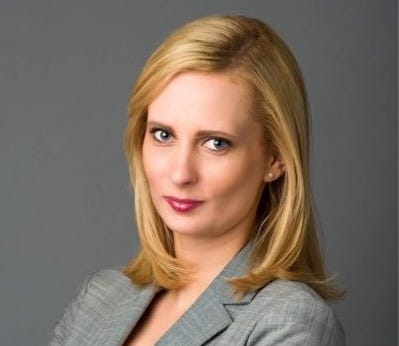
Ashley Baker is the executive director of the Committee for Justice and a FreeCon signatory.
An expert on judicial confirmations, Baker is an active member of the Federalist Society, where she serves as a member of the Regulatory Transparency Project’s Cyber & Privacy working group. Her writing has appeared in Fox News, USA Today, The Boston Globe, The Hill, RealClearPolitics, and elsewhere.
In a recent piece for the Washington Examiner, she argued that a lawsuit by Democratic attorneys general to block Paramount Skydance’s $110 billion acquisition of Warner Bros. Discovery misreads the facts, both about antitrust policy and about the movie business.
“Paramount has committed to maintaining both studios, releasing at least 30 theatrical films a year, and guaranteeing a 45-day theatrical window before video-on-demand,” Baker wrote. “And since Skydance took over last August, Paramount has nearly doubled its slate from eight films to 15. These commitments mean more production days, more crews, more stages booked, more location spending — precisely what the unions say they want protected, and the only real medicine for what ails Hollywood: too few movies worth leaving the house for.”
“Courts should weigh evidence, not rhetoric,” she concluded. “An industry that has lost half its audience in a generation needs no protection from more movies.”
In the mix
• At The Wall Street Journal, FreeCon signatory Donald Boudreaux rebutted populist claims that Alexander Hamilton was a full-throated protectionist who would have supported the Trump administration’s trade policies.
“It’s true that Hamilton endorsed some elements of the infant-industry argument for tariffs,” wrote Boudreaux and coauthor Phil Gramm, “but he did so because American industry then was indeed in its infancy. America today occupies a completely different position, with productivity per manufacturing worker in the U.S. about 10 times as great as in China, U.S. capital markets as large as the rest of the world combined, and America now in its second century of dominating innovation and technological development.
“The conditions that led Hamilton to support tariffs have long since disappeared. He never saw protection of domestic manufacturing as a long-term policy but rather insisted that ‘continuance of bounties on manufactures long established must almost always be of questionable policy.’”
• At The Dispatch, FreeCon signatory Jessica Riedl explained that the federal government’s broken budget process has produced gross fiscal irresponsibility and grave economic risk.
“In a city allergic to hard choices, it is absolutely vital to maintain a budget process that at least sets a framework for responsible decision-making and imposes guardrails that only supermajorities can waive,” wrote Riedl, a fellow at the Brookings Institution.
“The chaos we have seen—lurching from government shutdowns to debt-limit standoffs to trillion-dollar Christmas-tree bills that no lawmakers have read—is not merely embarrassing. It is expensive: The collapse of the budget architecture has yielded the steepest budget deficits among the 38 countries the Organization for Economic Co-operation and Development.”
• At Law & Liberty, FreeCon signatory Tyler Syck reviewed three novels of Robert Harris that relate the life story of the Roman philosopher and statesman Cicero.
“The Harris narrative shows that as maddening and corrupt as politics may be, it is the only avenue through which meaningful political change is likely to be effected,” wrote Syck, an assistant professor of politics and the director of the Center for Public Service at the University of Pikeville. “For every evil, scheming, would-be tyrant, the book introduces us to at least one well-meaning but naïve individual with little to no ability to navigate the choppy waters of political reality.”
“The story of Cicero offers us both greatness to aspire to and mistakes to learn from,” he observed, “all of which is the greatest gift any work of history (fictional or scholarly) can offer. After all, what is the point of history if not to serve as a moral guide to future generations?”
• At The Washington Post, FreeCon signatory Ramesh Ponnuru argued that the Populist Right’s turn against Supreme Court associate justice Amy Coney Barrett makes no sense.
“Even if conservatives were to judge her on the basis of how frequently she frustrates their policy objectives,” wrote Ponnuru, the editor of National Review, “she is nothing like Anthony M. Kennedy, a Republican appointee who often voted with the liberal justices on cases involving abortion, gay rights and the environment. Nor is she like David Souter, another Republican appointee, who voted with liberals on, well, everything.”
“You don’t have to agree with all of Barrett’s jurisprudence to recognize that she is, one, thinking about the law in a way that conservatives have championed for decades, and two, helping the court deliver one victory after another, both in legal and policy terms, for the right. Her opinions reflect a calm and fair-minded evaluation of the facts and arguments before her. Her right-wing critics obviously labor under no such constraints.”