
When Americans celebrate the 250th anniversary of the Declaration of Independence this summer, no one will cheer louder than Freedom Conservatives. We revere the American Founding. It is our mission to restore its guiding principles and apply them to the challenges of the 21st century.
Many of us have spent years preparing for our nation’s semiquincentennial. To our way of thinking, it encompasses not just this year’s celebrations of the Declaration but commemorations of other key events in the Founding era, including the 250th anniversary (in 2038) of the ratification of the U.S. Constitution.
FreeCon signatories and allies are publishing books and articles, releasing films and podcasts, hosting conferences, and organizing patriotic shows, concerts, ceremonies, and tours.
Moreover, as we celebrate key events in American history, FreeCons will seek to place them in a broader context of political and economic developments occurring around the world. The Declaration of Independence, for example, wasn’t the only document of lasting significance released in 1776. Also published that year were Adam Smith’s Wealth of Nations and the first volume of Edward Gibbon’s Decline and Fall of the Roman Empire. And it was 500 years ago this month that the first English translation of the Bible was smuggled into England.
Today we feature FreeCon discussions of these seminal moments in the history of our country and our world.
What a title!

Donald J. Boudreaux is a research fellow at the Independent Institute and professor of economics at George Mason University. He is also a FreeCon signatory.
In the latest edition of The Independent Review, Boudreaux contributed an essay to a symposium on the 250th anniversary of the publication of Adam Smith’s An Inquiry into the Nature and Causes of the Wealth of Nations.
“It’s no astonishing coincidence,” he wrote, “that Wealth of Nations appeared in the same year as America’s Declaration of Independence, Thomas Jefferson’s manifesto, which Milton and Rose Friedman described as ‘the political twin of Smith’s economics.’”
Adam Smith “clearly saw that the obvious and simple system of natural liberty was to be given unprecedentedly full rein in the fledgling new nation,” Boudreaux continued. About Revolutionary-era Americans, Smith wrote that “they are become statesmen and legislators, and are employed in contriving a new form of government for an extensive empire, which they flatter themselves, will become, and which, indeed, seems very likely to become, one of the greatest and most formidable that ever was in the world.”
An insufficiently appreciated fact about Wealth of Nations, Boudreaux wrote, “is that Smith did more than merely notice the market’s ability to incite strangers to cooperate productively with one another and to inform them about how best to carry out this cooperation; Smith was gobsmacked by this social cooperation.
“We — 250 years later — should be even more gobsmacked. Much more. The extent of the market and the number of its participants are far larger today than they were in the eighteenth century. And we have the much-higher standard of living to prove it.”
Other contributors to the Wealth of Nations symposium include FreeCon signatories and allies such as Daniel Klein, James Otteson, and Erik Matson.

Peak synthesis

Michael Munger is a professor of political science and director of the Philosophy, Politics, and Economics certificate program at Duke University. He is also a FreeCon signatory.
A past president of the Public Choice Society and former North American editor of the journal Public Choice, he also hosts the podcast “The Answer is Transaction Costs.”
In a recent Independent Review piece, Munger discussed Johan Norberg’s book Peak Human in the context of prior attempts to describe and explain “golden ages,” including Edward Gibbon’s magisterial Decline and Fall of the Roman Empire, the first volume of which was published 250 years ago.
Munger wrote that Gibbon “changed the classic view (‘Rome fell because men declined’) into what we would now recognize as a social science-based comparative statics argument: ‘Rome fell because institutions changed incentives.’”
“A number of modern authors, including most prominently Mancur Olson, have taken up this approach and applied it fruitfully in new contexts.”
Norberg’s Peak Human belongs to the same tradition as Gibbon and Olson, Munger continued, but “departs from both in important ways. Norberg is less fatalistic than Gibbon and less mechanistic than Olson, while nonetheless sharing their skepticism toward teleological accounts of history.”
“Peak Human offers a synthesis that neither Gibbon nor Olson quite achieved. It combines Gibbon’s sensitivity to historical contingency with Olson’s attention to incentive-driven institutional decay, while adding a cultural and ideological dimension that explains why societies so often choose restriction over discovery.”
Force for liberation
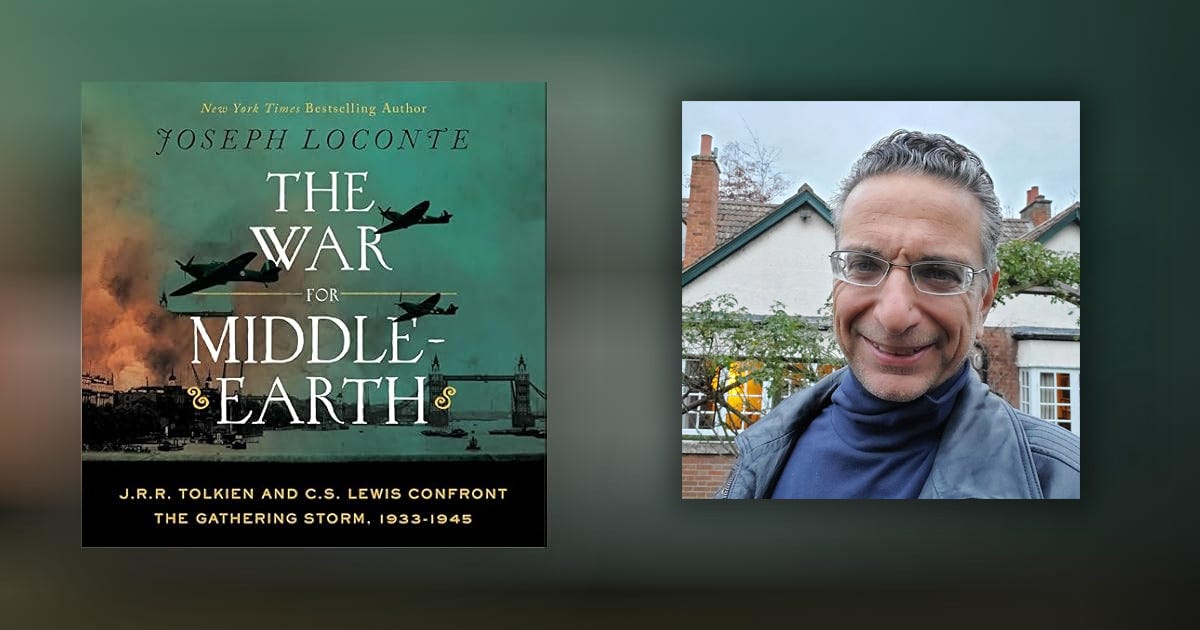
Joseph Loconte is a Presidential Scholar in Residence at New College of Florida and the C.S. Lewis Scholar for Public Life at Grove City College. A senior fellow at the Trinity Forum, Loconte is also a FreeCon signatory.
Among the books he’s authored are the bestseller A Hobbit, a Wardrobe, and a Great War: How J.R.R. Tolkien and C.S. Lewis Rediscovered Faith, Friendship, and Heroism in the Cataclysm of 1914-1918 and its follow-up The War for Middle-earth: J.R.R. Tolkien and C.S. Lewis Confront the Gathering Storm, 1933–1945.
In a recent Wall Street Journal piece, Loconte reflected on the 500th anniversary of the arrival in England of William Tyndale’s translation of the Bible into English. Because the authorities banned Tyndale’s work, it had to be smuggled into the country.
“The effect of his New Testament was electrifying and empowering,” Loconte wrote, “as men and women read or heard aloud the words of Jesus in English for the first time in their lives.”
“The democratization of Bible reading,” he continued, “became a potent force of liberation. Reformers soon wielded the Bible to confront oppressive political and religious regimes. The Protestant defenders of England’s Glorious Revolution of 1688, which deposed an autocratic monarch and established a constitutional government, were armed with a biblical text deeply rooted in Tyndale’s translation.
“So, too, were colonial Americans. As the historian Daniel Dreisbach has observed, the King James Bible was ‘the most accessible, authoritative, and venerated text in early colonial society.’ Thus in 1776, even Thomas Paine, a religious skeptic, drew from the Bible to make his famous case for American Independence. ‘That the Almighty hath here entered his protest against monarchical government is true,’ he wrote, ‘or the scripture is false.’”
In an earlier essay in The American Spectator, Loconte also observed that because Edward Gibbon’s Decline and Fall of the Roman Empire debuted in 1776, the American Founders had another compelling reason to focus on historical examples of failed states. “The fearsome story of Rome was near the forefront of their minds.”
In the mix
• At The Dispatch, FreeCon signatory Richard M. Reinsch II marked the anniversary of President Trump’s “Liberation Day” tariffs by chronicling their adverse effects.
“Tariffs are a very blunt form of taxation,” wrote Reinsch, editor-in-chief of Civitas Outlook. “They tax not only imported consumer goods but also intermediate capital goods. They lower workers’ real wages by making certain goods more expensive. They reduce the productivity of companies and capital by raising the prices of inputs and other goods used in business while protecting domestic industries, leading to inefficiencies and job losses in other sectors.
“We were promised liberation. Instead, we have relearned that tariffs are just taxes that slow down our strong economy and weaken America’s power.”
• At the Washington Examiner, FreeCon signatory Casey Given argued that plans in California and other states to impose wealth taxes could cripple charitable giving.
“Proponents of wealth taxes argue that government redistribution is a more equitable and reliable way to fund social priorities,” wrote Given, the president of Young Voices. “But this presents a false choice. A thriving society depends on both effective public institutions and a vibrant civil society.
“Weakening one in favor of the other is not a balanced approach — it’s a risky one.”
• At Providence magazine, FreeCon signatory Mark Tooley offered a faith-inspired case against the Christian Nationalism now rampant on the nationalist-populist Right.
Christ is “already securely Lord,” wrote Tooley, “no matter what happens on earth politically or otherwise, which He sifts and judges. We do serve Him by advancing authentic righteousness in society. But that cause is always complicated by the wheat and tares among us.
“It is not a project of installing the ‘right’ people in power. And righteousness often advances in providentially unexpected ways, sometimes through actors we deem adversaries.”
Tooley, president of the Institute on Religion and Democracy, concluded by arguing that rather than “restoring” America, which he called “an exercise in nostalgia,” the goal of Christians ought to be to “renew society, moving it forward.”
“A Christian Realist view, different from nearly all forms of Christian Nationalism, is that social righteousness advances haphazardly. There are rarely clear sheep and clear goats in this advance. Everyone is self-interested and short-sighted to various degrees. Yet Providence presides.”