
Among the hundreds of signatories to the Freedom Conservatism Statement of Principles are the authors of many important works of history, political and economic analysis, social commentary, cultural criticism, fiction, and other genres.
Among them are Ilya Shapiro (Lawless: The Miseducation of America's Elites), David L. Bahnsen (Full-Time: Work and the Meaning of Life), Catherine Ruth Pakaluk (Hannah's Children: The Women Quietly Defying the Birth Dearth), David Harsanyi (The Rise of BlueAnon: How the Democrats Became a Party of Conspiracy Theorists), Steve Hayward (Upon Further Review: Books and Arts, 1983-2020), George Hawley (The Moderate Majority: Real GOP Voters and the Myth of Mass Republican Radicalization), Daniel J. Mitchell (The Greatest Ponzi Scheme on Earth: How the US Can Avoid Economic Collapse), and Raymond J. Keating (Subversion).
Here are some recently published and upcoming works by FreeCon signatories and key allies.
Book report
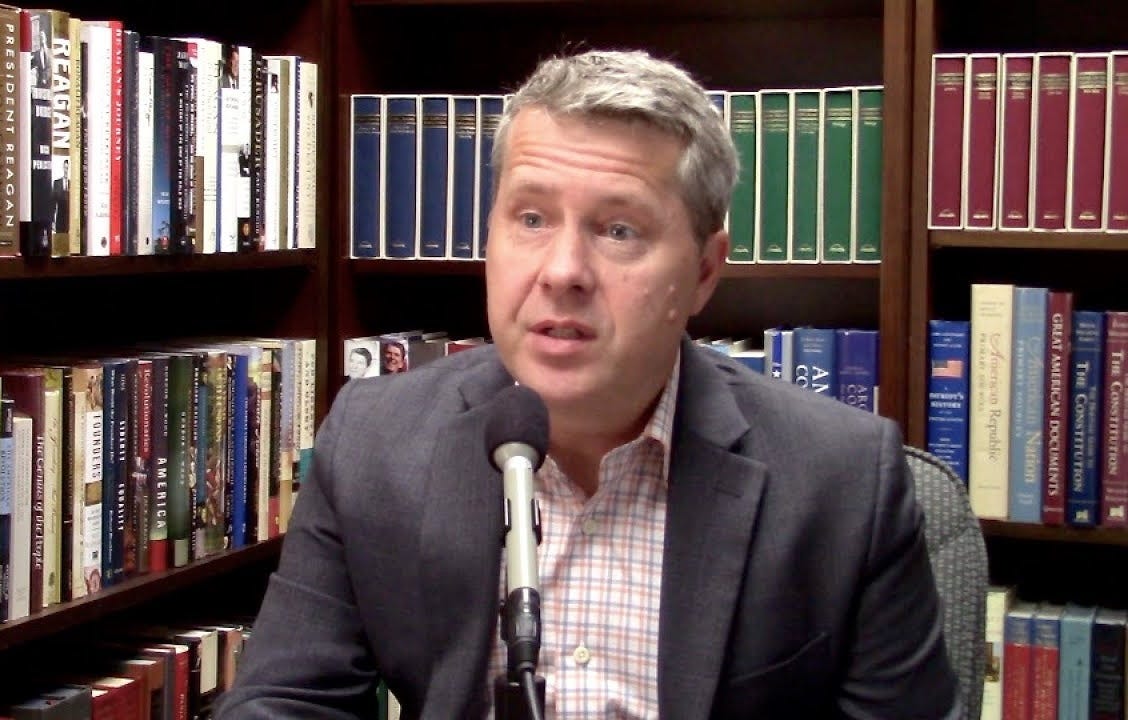
Andrew Taylor (pictured above), a FreeCon signatory and political scientist at North Carolina State University, is the author of A Tolerance for Inequality: American Public Opinion and Economic Policy, published last November by the University of Chicago Press.
Taylor’s book “breaks new ground and makes a significant intellectual contribution by focusing on those areas where the connections between economic and political inequality are least established,” said Matt Grossman.
• FreeCon signatory Bradley J. Birzer, Russell Amos Kirk Chair in American Studies and Professor of History at Hillsdale College, is the author of The Declaration of Independence: A Radical Experiment in Liberty, due out in May from the American Institute for Economic Research.
“Influenced by classical learning, the English constitutional tradition, Protestant political culture, and the philosophy of natural rights,” this book “presents the Declaration of Independence as both radical and deeply rooted in inherited traditions.”
Birzer‘s previous books include Russell Kirk: American Conservative (2015), Neil Peart: Cultural (Re)Percussions (2015), and J.R.R. Tolkien’s Sanctifying Myth (2003).
• Stephen Kent, a FreeCon signatory and principal of Better Media LLC, is the author of Great Escape: How Stoicism and Timeless Stories Can Change Your Life, If You’ll Let Them, due out later this year from Post Hill Press. His prior work includes How the Force Can Fix the World: Lessons on Life, Liberty, and Happiness from a Galaxy Far, Far Away.
Glen Beck described Kent’s first book as the “definitive analysis of how the virtues of Star Wars transcend political differences and can help us live better lives.”
• Stephanie Slade, a senior editor at Reason, is the author of Fusionism: Liberty, Virtue, and the Future of the American Right, which will be published in September by the University of Notre Dame Press.
Slade “brilliantly illuminates the truth that the free society is made possible by the creative tension between liberty and virtue,” raved Yuval Levin of the American Enterprise Institute. “This book is essential reading for conservatives of all parties.”
• Frank Lavin, a FreeCon signatory and former federal official and ambassador, is the author of Inside the Reagan White House: A Front-Row Seat to Presidential Leadership with Lessons for Today, published last year by Post Hill Press.
This “exceptional book” is “well-written, insightful, and chock full of first-hand experiences,” wrote one reviewer, offering “an informative view of how the political process works, or doesn't work.”
• Caleb Franz, a FreeCon signatory and program manager at Young Voices, is writing Becoming Ulysses: The Rise, Fall, and Redemption of Young Ulysses S. Grant. His first book was The Conductor: The Story of Rev. John Rankin, Abolitionism’s Essential Founding Father.
“Filled with original research, beautifully written passages, and emotionally resonant moments,” wrote one reviewer, The Conductor “emerges as a triumphant achievement in narrative history.”
• Alexandra Hudson, a FreeCon signatory and author of The Soul of Civility: Timeless Principles to Heal Society and Ourselves, is currently working on a follow-up book for young readers entitled Heroes and Villains: The Soul of Civility for Young Citizens.
In his review of The Soul of Civility, Freedom Conservatism co-founder John Hood wrote that by “deftly combining personal narrative, cogent argument, literary allusion, and historical example, Hudson urges readers not to despair about our present state of discourse but to do something about it.”

FreeCon v. NatCon

The Iowans for Tax Relief Foundation seeks to apply “the principles of limited government, free enterprise, and the rule of law to public policy” so that “all Iowans will have the opportunity to succeed.”
Earlier this month, the organization posted a point-counterpoint about the future of the American Right. Its policy director, John Hendrickson, argued that National Conservatism represents that future best, by preserving “what freedom alone cannot.”
Conservatives “should be cautious of free-market fundamentalism,” he wrote. “While markets are powerful tools, they are not ends in themselves.”
In his piece, FreeCon signatory Vance Ginn argued that “Freedom Conservatism beats National Conservatism every time.”
“Progressives have long preferred rule by executive action: agencies, emergency declarations, sweeping orders, and regulatory shortcuts,” wrote Ginn, who served as chief economist at the Office of Management and Budget during the first Trump administration. “What’s different now is how many on the right are tempted to use the same tactics for ‘good’ ends. That should set off alarms.”
National Conservatism is right to be concerned about “alienation, fragility, and institutional rot,” he continued, but “it’s wrong about the prescription. Executive-heavy populism, tariffs, and industrial planning are not a return to ordered liberty. They’re a new version of top-down management.
“Freedom Conservatism is better because it trusts people more than politicians. It protects the constitutional separation of powers. It rejects hidden taxes like tariffs. And it keeps the moral center of conservatism where it belongs: liberty under law, limited government, and free enterprise that lets people prosper.”
In the mix
• At Issues & Insights, FreeCon signatory Richard Lorenc argued that the embrace of socialism by members of Generation Z should come as no surprise.
“Social media focuses intensely on the alleged sins of capitalism — greed, ever-rising prices, unfairness — while largely ignoring its vast and no less tangible benefits: abundance, freedom, innovation, opportunity, expression, and variety,” wrote Lorenc, the president and CEO of Lexandria, an education nonprofit that seeks to reignite the American spirit through innovative classroom content and tools.
“It’s time for both a truce and the truth. If social media influencers wish to expose the system’s flaws (and they should!), they also should expose its virtues.
“It’s also time for the adults in the house to tell Gen Zers to ‘take a deep breath and show us what you’re made of.’ And remind them: If you make the economy grow, you’re free to share your wealth however you see fit.”
• At The Washington Post, FreeCon signatory Ramesh Ponnuru observed that Democratic candidates are again offering voters the promise of Medicare for All — even though its “political and policy deficiencies become impossible to ignore as soon as the debate moves beyond slogans.”
A big one is that the policy “requires the government to kick 181 million people off their employer-provided insurance, 36 million off their individually purchased policies and 35 million off their Medicare Advantage plans. Surveys regularly find that an overwhelming majority of those enrollees like their coverage.”
• At National Review, FreeCon signatory Jordan McGillis observed that, even as artificial intelligence is becoming more widespread, college graduates entering the job market still have an advantage over their non-college peers.
“The economic advantages of higher education remain substantial,” wrote McGillis, a fellow at the Economic Innovation Group.
“Technological change requires labor force adaptation; there is no doubt about that. College and non-college workers alike would be wise to stay abreast of market developments, sharpen their skills, and learn how to use AI to complement their contributions.”
Still, “the median pay for an American with a bachelor’s degree is more than 60 percent higher than the median pay for an American high school graduate. This gap has hardly budged over the past 25 years.”