
When it comes to strengthening our country‘s industrial base, creating new jobs, and expanding access to the American Dream for more workers and families, Freedom Conservatives do not disagree with National Conservatives and other voices on the Populist Right. We believe these are worthy goals.
Where we part company with our rivals is how best to pursue them. They believe government should more actively intervene in private markets — imposing stiff taxes on imports, protecting politically favored companies and sectors, and even taking ownership stakes in private businesses.
FreeCons do not deem it prudent to abandon core themes of modern American conservatism such as fiscal restraint, free trade, and technological innovation. We believe the problem is too little free enterprise, not too much.
“A corrosive combination of government intervention and private cronyism” is making basic goods and services “unaffordable to many Americans,” we wrote in the Freedom Conservatism Statement of Principles. “We commit to reducing the cost of living through competitive markets, greater individual choice, and free trade with free people, while upholding the rule of law, property rights, freedom of contract, and freedom of association.”
Today we spotlight FreeCon takes on innovation, dynamism, and the economic and political risks of NatCon policies.
Smart reshoring
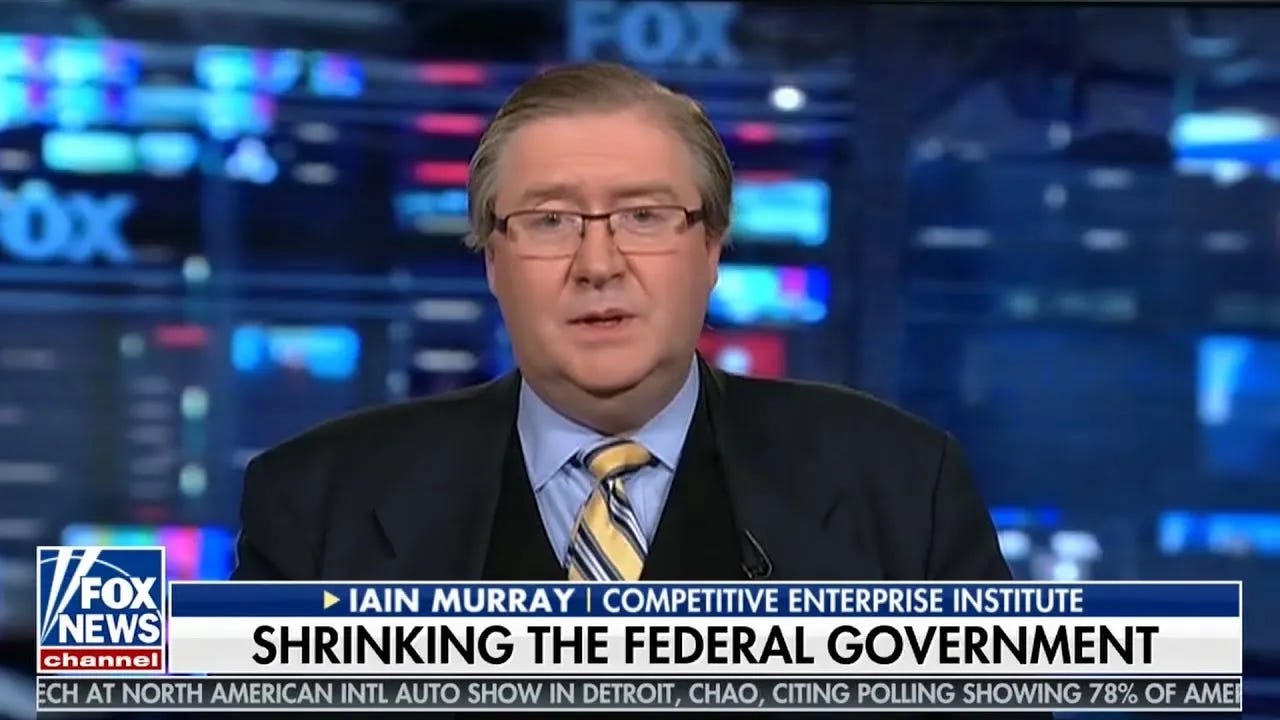
Iain Murray is vice president for strategy and senior fellow at the Competitive Enterprise Institute. He is also one of the founders of the Freedom Conservatism project.
In a recent article for The Daily Economy, Murray wrote that America won’t outcompete China by restricting imports on robots. “It will win by becoming the best place in the world to build and deploy them.”
“It is a major part of the administration’s policy to ‘reshore’ American manufacturing to bring back jobs,” he explained, “and a tenet of the National Conservatism movement that America needs blue-collar jobs that pay a good wage. Yet both of these propositions rest on the idea that manufacturing needs to be labor-intensive.”
What neither officials in Washington nor NatCon influencers seem to understand is that the best chance for reshoring manufacturing capacity is to seek more automation of industrial processes, not less.
“That means more robots, but the administration has recently moved to restrict the import of robots, specifically humanoid robots from China,” Murray wrote. “The more hostile the administration is to automation, the more it will drive manufacturing back offshore.”
“Restricting access to robot hardware cannot be the answer. The sensible response is to make America the best place to invent, improve, and deploy robots in new and remarkable ways.”
Wages to win

Jordan McGillis is a fellow at the Economic Innovation Group, the former economics editor at City Journal, and a FreeCon signatory.
Reporting the findings of a new Echelon Insights survey conducted for EIG, McGillis wrote that “American workers across partisan divides think the president’s economic agenda has failed them — and on the single issue they care about most, the cost of living, workers say the president’s policies have made their problems worse.”
Workers place high prices, housing affordability and taxes at the top of their priority list, explained McGillis and coauthor John Lettieri.
“And it’s on this paramount cost-of-living issue that workers disapprove of the president’s performance the most. Only 22% of workers grade President Trump’s performance on inflation and the cost of living as good or excellent, compared to 62% who say it’s been poor. Even among those who voted for Trump in 2024, only 46% give him positive marks.”
“American workers are dissatisfied with the direction of the economy and dissatisfied with economic policies that fail to deliver higher wages and greater purchasing power. The lesson of recent elections is that these sentiments spell bad news for the incumbent party — even when other economic indicators, such as job growth and the stock market, are robustly positive.”
Wrong war

Tanner Nau is a reporting fellow at National Review, a former editorial fellow at The Free Press, and a FreeCon signatory.
In a recent National Review piece, Nau reported on a new Advancing American Freedom paper chronicling the cost of the Trump administration’s taxes on imports from Canada and their ineffectiveness as a tool for strengthening America’s manufacturing sector.
The study compared the year before tariffs (March 2024 to February 2025) with the latest year of trade data (July 2025 to June 2026) and concluded that manufacturing rose by just 0.4%. “Although imports from Canada fell, the United States turned to imports from other trading partners rather than spurring domestic manufacturing,” the report found.
“The U.S.-Canada trade war has not just resulted in a shifting of the North American economic order,” Nau continued, “but has produced tremors in this year’s midterm elections, becoming an issue in key battleground states like Michigan and Maine.
“The National Taxpayers Union Foundation estimates that the tariffs levied against Canadian imports cost the state an estimated $23 billion, and $5,619 per Michigan household, the largest per-household cost in the nation.”
Mark your calendar
Freedom Conservatives and allies will have multiple opportunities to gather after the 2026 midterms to discuss the results and help chart a new course for the American Right. For example:
• The Goldwater Institute, the 1912 Institute, and other partners will host FreeCon Phoenix on Monday, November 16 from 8am to 5pm at the Westin Phoenix Downtown. Clint Bolick, justice on the Arizona Supreme Court and co-founder of the Institute for Justice, will deliver the keynote address. Click here to find out more about FreeCon Phoenix.
• The National Review Institute, the Commonwealth Foundation, and other partners will host FreeCon Philadelphia on Tuesday, November 17 from 3pm to 7pm. Former U.S. Sen Pat Toomey and Pennsylvania Attorney General Dave Sunday will deliver remarks at the event, which will be held at at the Union League in Philadelphia. Click here to find out more about FreeCon Philadelphia.
• The John Locke Foundation, Carolina Journal, the Competitive Enterprise Institute, and other partners will host FreeCon Raleigh on Wednesday, November 18 from 4pm to 8pm at the Renaissance Raleigh North Hills Hotel. Delivering the keynote address will be Stephanie Slade, senior editor at Reason magazine and author of the new book Fusionism: Liberty, Virtue, and the Future of the American Right. Click here to find out more about FreeCon Raleigh.
• Also on November 18, the Foundation for Research on Equal Opportunity (FREOPP) will host its annual Freedom & Progress Conference from 8am to 4:30pm at Le Méridien Washington/The Madison. Several FreeCon signatories will speak at the event, and there will be a working-group session devoted specifically to Freedom Conservatism. Click here for more information about Freedom & Progress 2026.
In the mix
• At the Los Angeles Times, FreeCon signatory Dave Hebert examined the new “Board of Trade” arrangement recently released by Washington and Beijing.
“Every time trade disputes have escalated between the U.S. and China, the resulting truce has required something to announce,” wrote Hebert, director of economics and economic freedom at the American Institute for Economic Research. But such announcements usually amount to little.
“After almost two years of tariffs being announced, paused, reversed and announced again under a different heading, the administration has now created a board that might lower a few of them. California’s growers lost a large portion of their Chinese customers to a trade war that Washington started and families around the country have been paying higher prices. A board with two pages of governing documents does little to fix this.”
• At The Wall Street Journal, FreeCon signatory Jack Butler diagnosed the Republican Party’s “groyper problem.”
Groyper refers to fans of Nick Fuentes, the racist influencer, and more generally to “the menagerie of disturbed, young, mostly male right-wingers who seem increasingly involved in Republican politics,” wrote Butler, deputy editor of the Journal’s Free Expression newsletter. They “could become for the right what the anti-Israel crowd is for the left: a vocal, rabid constituency that must be placated.”
“That transformation of the left began about a decade ago,” he continued, and many Democrats then “didn’t think it was a big deal.” But “the greatest trick the devil ever pulled was convincing the world he didn’t exist.”
• At The Hill, FreeCon signatory Edward Lopez predicted that GOP attempts to make the 2026 midterms about the president, or about fanciful promises of fiscal dividends to American voters, will fare no better than the comparable strategy embraced by former Hungarian leader Victor Orban.
“After 16 years in power, late in 2025, Orban began to realize that his April reelection bid was in jeopardy,” wrote Lopez, a professor of Economics at Western Carolina University. So Orban offered political giveaways, capped prices, and injected public funds into private companies. “His party lost in a landslide. Orban has been out of power since.”
“Whether it’s Trump, Orban or Vance, opening the fiscal purse to appease a grumbling public is a classic move made by history’s practitioners of clientelism.”
• At The Washington Post, FreeCon signatory Ramesh Ponnuru explained why economically minded voters appearing to be swinging against Republicans in key midterm races despite the country’s relatively low unemployment rate and solid second-quarter growth in gross domestic product.
“Prices are too high and still rising too fast,” wrote Ponnuru, the editor of National Review and a fellow at the American Enterprise Institute. “Real wages have thus been falling. Add in that President Donald Trump has instituted some policies that raise prices, has signaled in many other ways that lowering prices is not a top priority for him and has repeatedly dismissed cost-of-living concerns, and it’s not at all surprising that voters are unhappy.”
The rising stock market is good news “but wages matter more than stocks for most households,” he observed.