
“Do you know what time it is?”
Of all the vacuous catchphrases uttered by nationalists and populists, this one is the most familiar — and the most obnoxious. It isn’t really a question, of course. Nor is it a good-faith invitation to debate first principles, evaluate evidence, or argue policy particulars.
Its rhetorical purpose is to evade such discussions by declaring them moot, pointless, even perilous. Asking “Do you know what time it is?” with either mock exasperation or preening bravado is meant to shut opponents up, not engage them. Given the precarious state of the republic and the radicalization of the Left, say National Conservatives and their allies, the American Right must resort to extreme measures to avert imminent disaster.
Don’t take our word for it. The media strategist and Claremont Institute fellow who appears to have coined the phrase, David Reaboi, made its meaning explicit. America’s public and private institutions are “crumbling,” he said in 2021, “and the surest way to get to something better is to allow them to crumble — and for as many people as possible to recognize that these things are, indeed, crumbling.”
His Claremont colleague and fellow NatCon signatory Michael Anton established the rhetorical template in his overheated “Flight 93” essay from 2016. The only alternatives to rule by the populist-nationalist Right, he argued, were “Caesarism, secession/crack-up, collapse, or managerial Davoisie liberalism as far as the eye can see … which, since nothing human lasts forever, at some point will give way to one of the other three.”
Freedom Conservatives reject the silly notion that these are, in fact, America’s only choices — and the not-so-silly, frankly authoritarian implication that refusing to accede to the Populist Right’s hijacking of American conservatism is tantamount to surrendering our country to violent mobs.
At the 2026 Freedom Conservatism Conference, held May 20 in Washington, several featured speakers discussed these and related issues and great length. Today we offer excerpts of their remarks.
Ideas that work
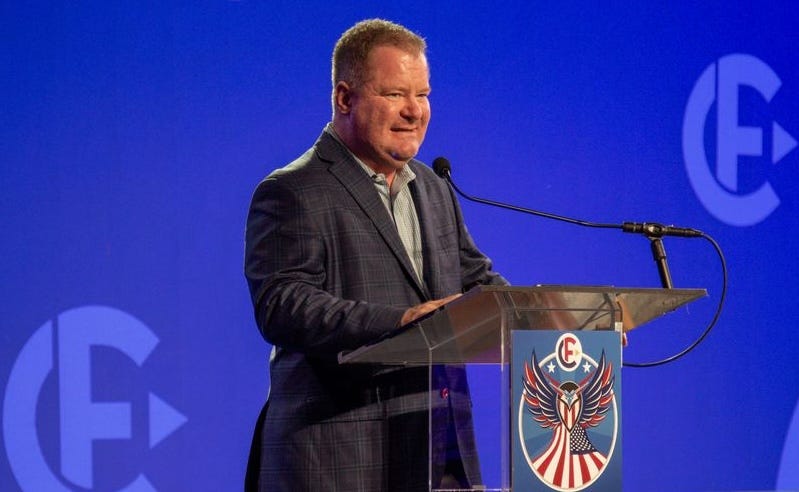
Erick Erickson hosts a nationally syndicated program for Atlanta radio station WSB and writes a column distributed by Creators Syndicate.
A former editor-in-chief of RedState.com, practicing attorney, and commentator at CNN and Fox News, Erickson served for nearly four years on the city council of Macon, Georgia.
During his speech at the 2026 Freedom Conservatism Conference in Washington, he referenced the Populist Right’s frequent accusation that FreeCons committed to limited government, constitutional safeguards, and constructive dialogue among Americans of differing views “don’t know what time it is.”
“It is time, they say, for a new system,” said Erickson. “A new movement. A new strongman. A new revolution from our side of the aisle.”
But in reality, he continued, the nationalists and populists “mean to use our movement as a costume while they smuggle in the very ideas — the central planners, the tariffs, the strongmen, the grand designers — that conservatism exists to resist.”
“We know our ideas are still right,” Erickson concluded. “Progressives have no sense of history because they always ‘move on’ from it and circle back to the bad ideas of the past.”
As for “our friends on our side who have gone a little wobbly,” Erickson urged them not to “embrace the ideas on the ash heap of history” but instead to “hold firm to what works — because, at the end of the day, the markets do work, and families work, and individuals work, and Washington rarely ever does.”
Resetting the clock

Ramesh Ponnuru is the editor of National Review, a columnist for The Washington Post, a senior fellow at the American Enterprise Institute, and a FreeCon signatory.
During his speech at the 2026 Freedom Conservatism Conference, held May 20 in the nation’s capital, Ponnuru observed that “those of us who retain the skepticism about ambitious government that once seemed to define the Right are ceaselessly told that we are obsolete. We do not, the cliché has it, know ‘what time it is.’
“It is, to judge from various articles and social-media posts, a time for strongman rule; a time to let go of a Constitution that has served our country reasonably well (exceptionally well when we have actually adhered to it); a time to forget everything we have ever learned about how government plans can go awry.”
Ponnuru described many positive trends that ought to “reset the clock” for wayward conservatives, such as the recent spate of tax cuts and school-choice reforms by conservative-led states and legal victories on racial preferences, religious freedom, federalism, and the separation of powers.
“We Freedom Conservatives know it is not 1981,” he observed. “We face different problems than Ronald Reagan did, and the solutions must be different too. Some of us had been saying so for years before our self-appointed timekeepers came along. The Left is different too, and thus also the character of the battles.
“But we also know that the changes in our circumstances have made some free-market, limited-government reforms more urgent rather than less.”
Our time is coming
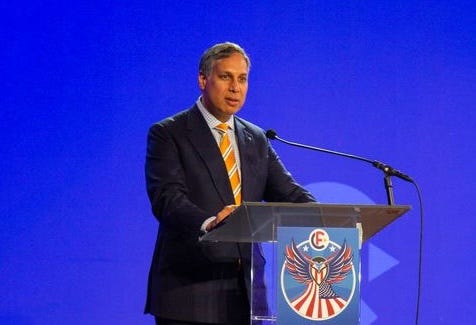
Avik Roy is co-founder and chairman of the Foundation for Research on Equal Opportunity (FREOPP) and one of the creators of the FreeCon project.
During his opening remarks at the 2026 Freedom Conservatism Conference, held May 20 at Capital Turnaround in Washington, Roy quoted a recent defense of American Exceptionalism by Secretary of State Marco Rubio as well as an earlier defense by former Rep. Jack Kemp of the “American idea” that “the Declaration of Independence applies to every individual,” that “everyone should have the opportunity to rise as high as their talents and efforts can carry them,” and that “while people move ahead, we should endeavor to leave no one behind.”
“Our ideological competitors on the Left and Right think such sentiments are quaint and passé,” Roy continued. The rise of these “supposedly post-liberal ideologies was disorienting to many of us. Post-liberals declared the death of the American idea and argued that the very concept of an American idea was a lie — that America was just like any other country, just a collection of people who share the same blood and soil.”
Freedom Conservatives know better, he concluded, “and our time is coming once again.”
In the mix
• At The Wall Street Journal, FreeCon signatory Neil Chilson wrote that a proposed “Artificial Intelligence Oversight Act” would serve the interests of China far more than those of the United States.
“Excessive regulatory burdens hurt U.S. AI exports, deter investment, and will push global developers toward China’s AI ecosystem,” wrote Chilson, head of AI policy at the Abundance Institute.
“To secure U.S. dominance in military AI, Congress should focus on cutting red tape, from power plant rules to the Pentagon’s outdated acquisition system — areas where China’s advantages are becoming insurmountable.”
• In a recent American Enterprise Institute paper, FreeCon signatory Robert Maranto described the many failings of today’s so-called scholarly journals and offered a practical strategy for reforming them.
“Improving the ecosphere of scholarly publishing across fields is not only a worthwhile endeavor,” wrote Maranto, a University of Arkansas scholar and editor of the Journal of School Choice, “but one that is consequential for reforming higher education and improving American discourse.”
• At CapX, FreeCon signatory Samuel Gregg advised conservatives not to fall for the pitch that “their side” can plan an economy more successfully than the Left can. “Industrial policy is,” he wrote, “a dead end.”
“If governments throw enough money at something, they will get some results,” wrote Gregg, president of the American Institute for Economic Research. “But the long-term damage in terms of opportunity costs, overproduction of goods for which there is weak demand, severe capital malinvestments, and unbridled cronyism are there for all with eyes to see.”