
Among the 388 signatories to the Freedom Conservatism Statement of Principles are some of the best-known leaders, activists, and commentators in American public life.
They include former Vice President Mike Pence, longtime columnists George Will and Karl Rove, commentators Alyssa Farah Griffin and Jonah Goldberg, former governors Larry Hogan and Jeb Bush, scholars Charles Murray and Wilfred McClay, activists Grover Norquist and David McIntosh, and editors and writers for such media outlets as National Review, Forbes, Christianity Today, The Wall Street Journal, The Washington Post, the Washington Examiner, The Dispatch, The Free Press, and The Boston Globe.
But the ranks of FreeCons also include many emerging leaders across the conservative movement — those still in the early stages of careers in public policy, politics, journalism, the academy, or the law.
Today we feature the work of recent signatories to the FreeCon statement whose leadership will serve our cause well in the coming decades.
For tech dominance
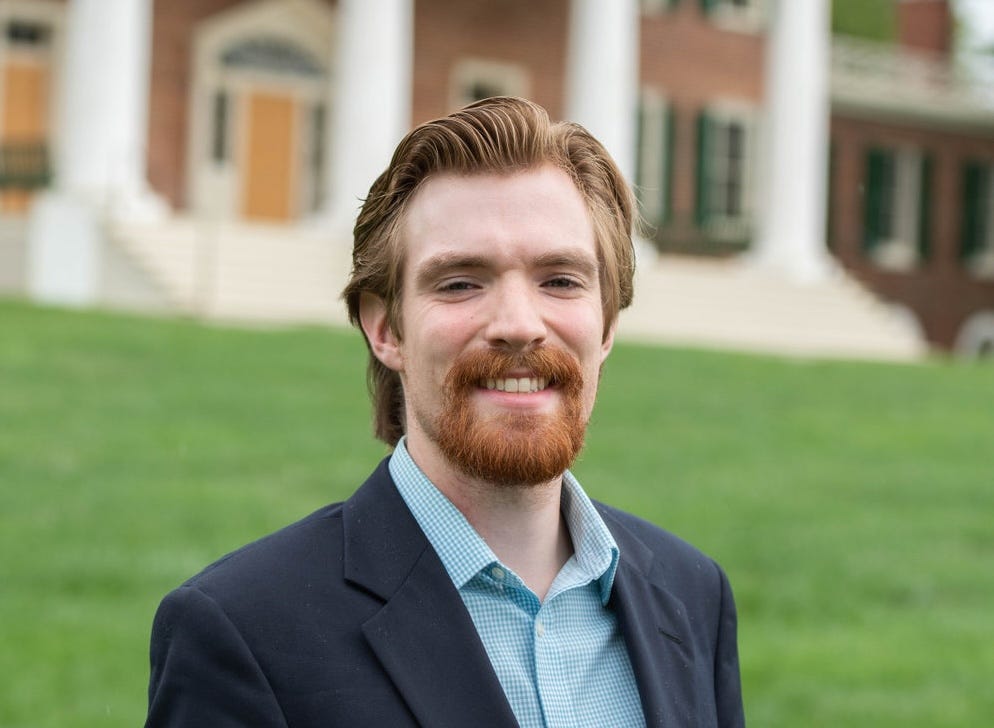
James Erwin is director of innovation policy at Americans for Tax Reform and a FreeCon signatory.
A former Capitol Hill staffer, Erwin serves as executive director of Digital Liberty and writes frequently for such media outlets as The Hill and The Federalist.
In a recent column for RealClearMarkets, he criticized a congressional effort to give American companies right of first refusal to buy advanced AI chips from American producers before they are exported.
“If the U.S. is to get the world building AI on American chips, as President Trump and AI czar David Sacks have challenged us to, restricting our companies’ market access is the opposite of what we should do,” Erwin wrote.
Supporters of the legislation have good intentions, he concluded, but “to help American tech dominance they should focus instead on getting more nuclear reactors and natural gas liquefaction plants online through streamlined permitting and environmental reviews” while “eliminating barriers to workforce development or apprenticeships.”
Disagree accurately

Elizabeth Doll is the director of Braver Politics at the civil-dialogue organization Braver Angels. She is also a FreeCon signatory.
Dole previously worked for the Family Policy Institute of Washington and on Republican campaigns for county office, judgeships, state legislature, and governor.
At Braver Angels, she and her colleagues assist candidates, elected officials and their constituents in finding common ground where they are unaware it exists, depolarizing political conversations, and helping elected officials and constituents understand and hold space for people with different opinions while respecting and caring for their humanity, even if they still disagree.
At the organization‘s recent workshop in southeastern Washington, Doll explained the organization’s philosophy and why its work in the state is important.
Braver Angles seeks not to downplay disagreement but to help participants learn to “disagree more accurately,” she told the Spokane Spokesman-Review, and the state of Washington is a good place to do it because “its political and identity diversity” is “unlike virtually anywhere else in the country.”
Core constitutional protection
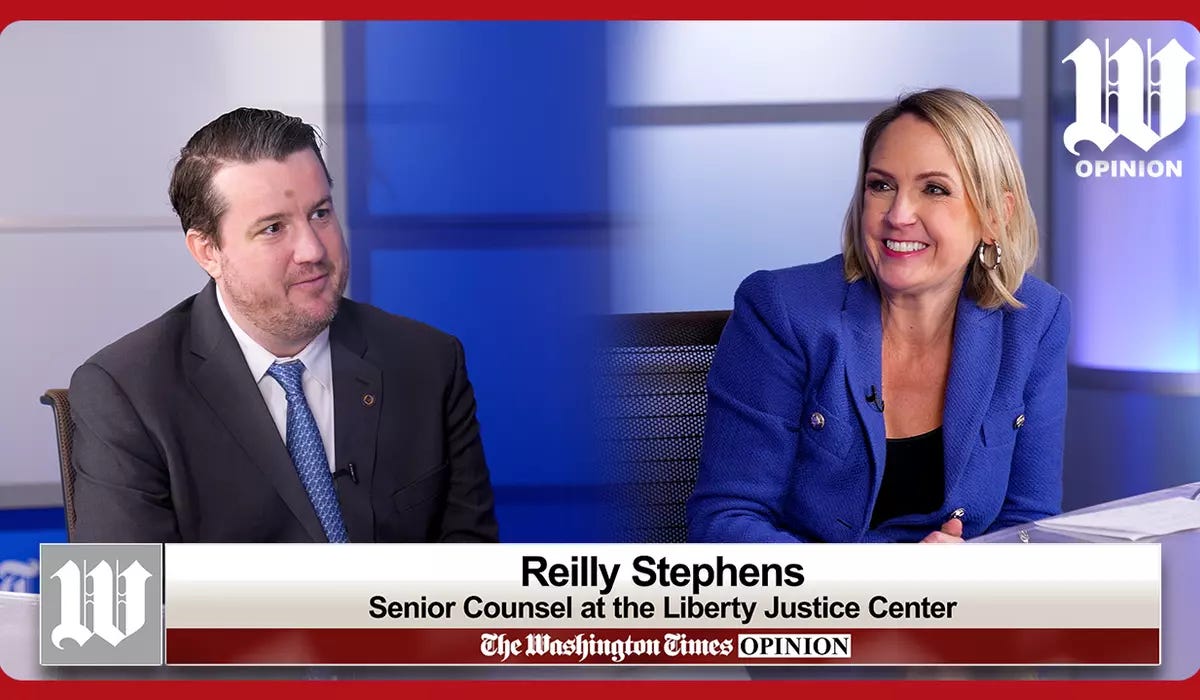
Reilly Stephens (left) serves as senior counsel and director of amicus practice at the Liberty Justice Center. He is also a FreeCon signatory.
In his current role, Stephens litigates cases in state and federal courts around the country on such subjects as free speech and association, campaign finance, labor law, search and seizure, property rights, educational freedom, federalism, equal protection, due process, and the separation of powers.
A former Antonin Scalia Fellow, he has offered commentary on constitutional issues to such outlets as National Review, the Washington Examiner, Real Clear Policy, and Gray Television.
The Liberty Justice Center has just filed an amicus brief in the case of a California county attempting to collect fines from a church that held indoor services during the pandemic. The U.S. Supreme Court has already ruled that similar restrictions on religious worship during COVID violated the federal constitution.
“Religious exercise is a core constitutional protection, and local governments need to respect those rights, even where it’s inconvenient for them,” Stephens explained. “Imposing fines for illegal restrictions validates the government’s bad behavior, and we hope the Supreme Court takes up the case and affirms the church’s rights once and for all.”
In another case, the Liberty Justice Center successfully pressed a casino developer to abandon racial preferences.
“No one should be excluded from participating in our economy on the basis of their race or sex,” Stephens told Cook County Record. “We are glad to see Bally’s new offering allows the people of Chicago to invest in one of the city’s premier projects without discrimination or exclusion.”
Green deception
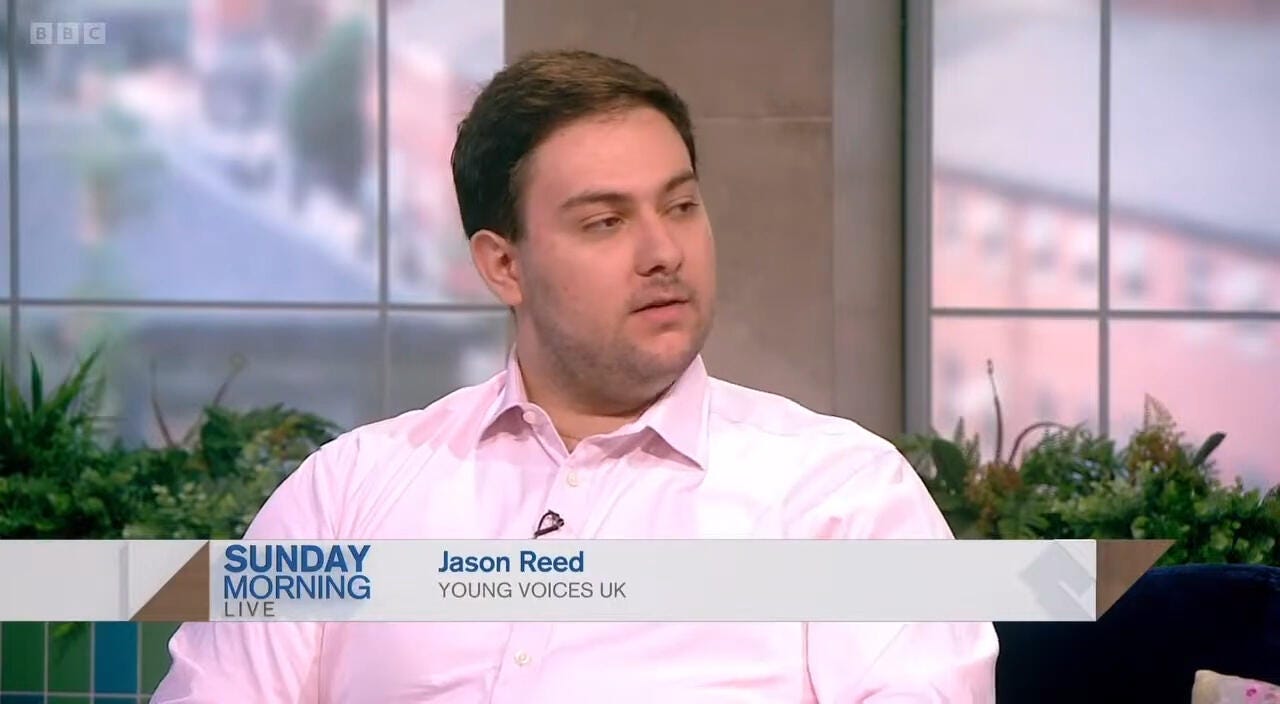
Jason Reed is the partnerships manager at Young Voices, overseeing various projects across North America and Europe to assist emerging journalists and commentators. He is also a FreeCon signatory.
Reed is also a policy and political analyst in his own right, appearing in a wide range of outlets in various countries on such matters as energy, the environment, obesity, taxes, and technological innovation.
In a recent essay for the journal Meer, he decried the deceptive marketing of companies seeking to earn political points with extravagant environmental claims.
“For example, the trend of labeling products as ‘palm oil free’ to appeal to environmentally conscious shoppers can be deceptive,” Reed wrote. “This marketing aims to associate palm oil production with deforestation. But the reality is rather different. By avoiding palm oil, as these ads claim, manufacturers must switch to a different oil.
“Those oil alternatives might include rapeseed, coconut, or soybean. But those oils are generally much less land-efficient than palm oil. That means going for a ‘palm oil-free’ product often translates into even more deforestation occurring, not less, which is a disaster for the planet.
“But some brands seem happy to let consumers remain oblivious.”
In the mix
• In The Washington Post, FreeCon signatory Ramesh Ponnuru observed that despite all the electoral lightning and rhetorical thunder, Trump and the MAGA movement have neither embodied or implemented a coherent alternative to American conservatism — and “few influential Republicans have even been calling for one.”
Ponnuru, the editor of National Review and a fellow at the American Enterprise Institute, cited multiple examples of administration policies failing to match the pre-election hype or the stated goals of the nationalist-populist Right.
Meanwhile, at the state level, “Republican governors are presiding over what previous generations of Reaganites might have considered paradise, with taxes being flattened, educational choice expanded and union membership declining.”
On the other hand, political writers “tend to dwell on questions of ideology and policy,” he concluded, while “the most striking changes in the Republican Party, conservatism and our political culture in general over the past decade do not directly concern such questions.
“Conspiracy theories circulate more widely than ever. The search for factual truth is less practiced and less respected. Corruption raises fewer eyebrows. Our debates are dumber and more thuggish. Trump and those who excuse his worst behavior are not solely responsible for these trends, but they have contributed greatly to them.”
• At National Review, FreeCon signatory Richard Lorenc argued that strong reading skills and a rigorous education in history, civics, and the classics remain the key to good citizenship.
“Today, with American society bitterly divided, civic education couldn’t be more necessary, not only for immigrants but for native-born Americans as well,” wrote Lorenc, the president and CEO of Lexandria, an education nonprofit that seeks to reignite the American spirit through innovative classroom content and tools.
This can’t be done in our schools alone, he concluded. Parents must take the lead and “push back” against both popular culture and the education bureaucracies. “That’s best done in their homes.”
• At The Dispatch, FreeCon signatory Jessica Riedl warned that if Congress enacts another budget-reconciliation bill in 2026, it is likely to widen, not narrow, the federal government’s already yawning budget deficits.
“While conservative Republicans may push for Reconciliation 2.0 with the best of intentions,” wrote Riedl, a Brookings Institution fellow, “it is overwhelmingly likely that any initial savings provisions would be quickly jettisoned and replaced with new tax reductions and spending expansions to protect vulnerable Republicans up for reelection and give President Trump another budget-busting win.
“The best way to stop this runaway train is to not let it out of the station in the first place. Unfortunately, there is not a sufficient presidential or congressional constituency for major spending cuts in 2026, and that means conservatives should not awaken the sleeping giant of reconciliation.”