
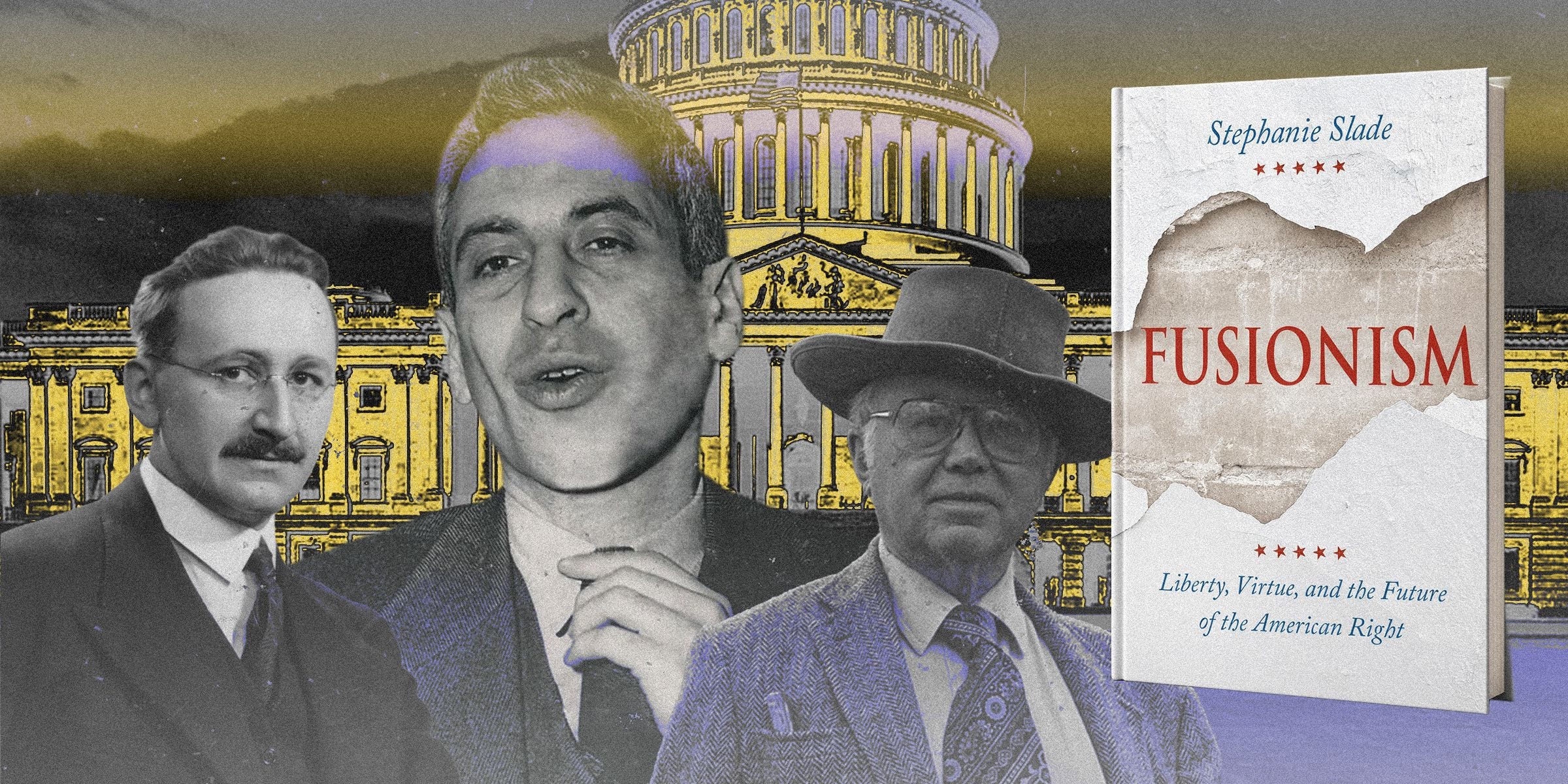
Among the hundreds of signatories to the Freedom Conservatism Statement of Principles — and the many thousands of other political leaders, thinkers, communicators, educators, litigators, and activists who advance our cause in their daily work — are many who call themselves “fusionists” or otherwise affirm the philosophical synthesis of liberty and virtue associated with the likes of Friedrich Hayek, Frank Meyer, and Ronald Reagan.
Other FreeCons describe their deeply held values and strongly preferred policies in different terms but still recognize fusionism as an essential feature of the Center-Right movement of which they are members.
It comes as no surprise, then, that so many Freedom Conservatives have reacted to the publication of Stephanie Slade’s new book Fusionism: Liberty, Virtue, and the Future of the American Right with excitement, appreciation, and approbation.
“Slade brilliantly and artfully tells the story” of the founding of the modern American Right and “offers brand new insights into the twentieth century,” raved FreeCon signatory and Hillsdale College professor Bradley J. Birzer. “I love it so much, I'm now reading it for a third time.”
Another signatory, University of Alabama professor George Hawley, observed that Slade’s book shows why fusionism remains “the clearest path out of our present impasse.”
Today we feature other reviews of Fusionism from Freedom Conservatives.
Sticky term
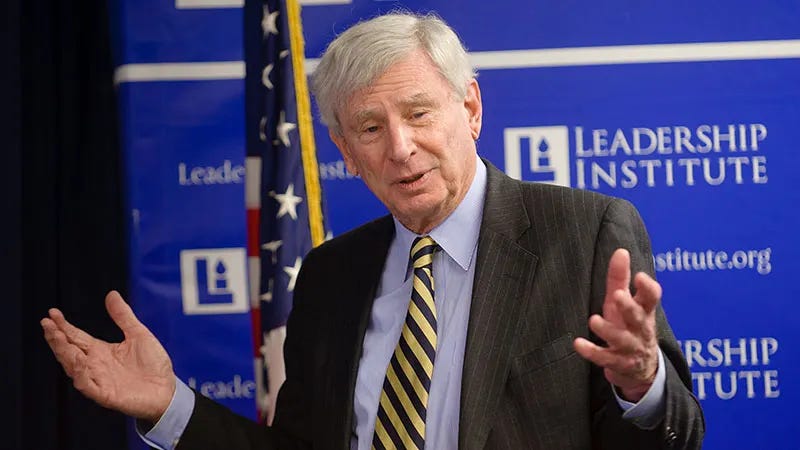
Donald Devine is a senior scholar at the Fund for American Studies and a FreeCon signatory.
In a review for The American Spectator of Stephanie Slade’s new book Fusionism: Liberty, Virtue, and the Future of the American Right, Devine raved that Slade’s account of fusionism is “simply perfect in presenting what one needs to know about the political philosophy that produced post-World War II American conservatism, and what is required to revive it today.”
“Slade’s story starts by confronting the term ‘fusionism,’ a designation actually given to the movement by one of its opponents,” he wrote, “just as capitalism’s title had been given to it by communism’s Karl Marx. Fusionism’s philosophical founders preferred designations like ‘tension’ and ‘synthesis,’ but like the term capitalism, fusionism stuck.”
The author introduces Friedrich Hayek as a libertarian and Russell Kirk as a traditionalist, as if they were opposites, but later concludes that both were “in fact freedom and traditionalist fusionists,” Devine pointed out.
Slade “importantly distinguishes between political and philosophical fusionism,” he wrote. “What is clear philosophically is not necessarily so when synthesized into practice.”
What is freedom for?
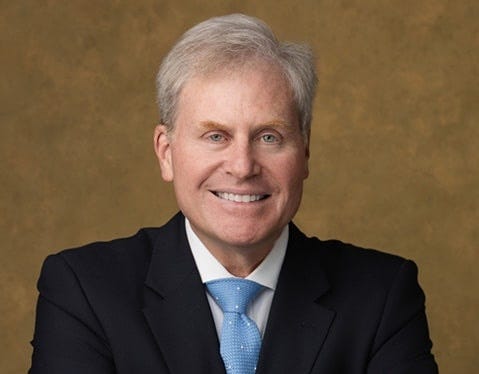
Mark Miller is the director of environment and natural resources litigation at the Pacific Legal Foundation. He is also a FreeCon signatory.
In a National Review piece about Stephanie Slade’s new book Fusionism: Liberty, Virtue, and the Future of the American Right, Miller commends the author for describing “the central dispute on the American Right more clearly than anyone else has.”
Fusionism is “a philosophical synthesis developed in the 1950s and ’60s,” he wrote, “holding liberty and virtue together. The two sides of that synthesis began from different concerns. Classical liberals emphasized individual freedom, private property, free markets, limited government, and protection against concentrated political power. Traditionalists like Russell Kirk, on the other hand, emphasized religion, family, community, inherited wisdom, and the moral order.”
“Fusionism argued that these commitments were not rivals; virtue supplied the purposes for which freedom should be used.”
Miller explained that members of the so-called Dissident Right may be deeply misguided in their policy prescriptions but they do raise an issue that many young conservatives find salient: What is freedom for?
“Explaining why government planning and too many regulations are bad is not the same as explaining why economic freedom is good,” he wrote. “The modern fusionist argument increasingly stopped too soon. It became less adept at explaining what economic freedom allows people to build.”
“Slade’s answer, as the book’s title telegraphs, is a return to fusionism: Government must preserve the freedom by which virtue can be chosen. Families, churches, communities, and other voluntary institutions must then form individuals capable of using that freedom well.”
Message vs. substance
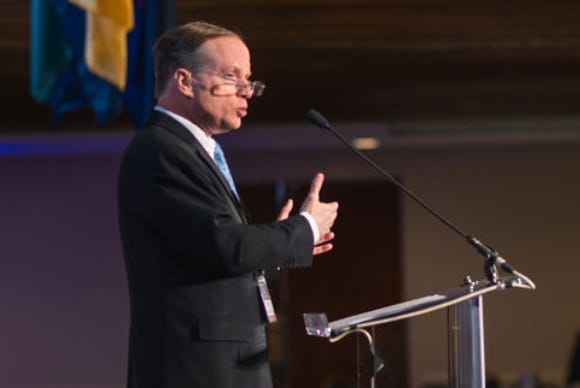
John Hood is president of the Pope Foundation, a North Carolina-based grantmaker, and former writer for such organizations as the Heritage Foundation, the American Enterprise Institute, and the Cato Institute. He is also co-founder of the Freedom Conservatism project.
In a recent Carolina Journal review of Stephanie Slade’s new book Fusionism: Liberty, Virtue, and the Future of the American Right, Hood wrote that her “magisterial work describes the creation of modern American conservatism during the 20th century and the philosophical insight at its core — that our republic cannot survive without a strong commitment to both liberty and virtue.”
“I particularly appreciated the distinction Slade makes in her book between messaging and substance,” he continued. “In the American context, the job of conservatives is to conserve the principles of the Founding. These include the classical liberalism of individual freedom and legally enforceable rights as well as the classical republicanism of representative bodies, checks and balances, and civic virtue. ”
“An American Right seeking to conserve and apply these principles to modern-day problems would shrink deficits, not expand them; free the economy, not attempt to steer it; devolve power, not centralize it; and combat the grievance politics and other worse tendencies of modern progressivism, not mimic them.”
Leaders of the Dissident Right “certainly have adopted a rhetorical extremism” to “whip their base into an emotional froth,” Slade writes, but on substantive policy issues, they are “supremely flexible, even mushy.”
Hood agreed. “On economics, foreign policy, and the constitution,” he wrote, “they are certainly to my left, not my right.”
More Slade
You can read excerpts of Fusionism at The Dispatch, Reason, and The Wall Street Journal.
Slade has also appeared on podcasts hosted by Freedom Conservatism signatories and allies. We commend to your attention, for example, this Saving Elephants interview by Josh Lewis, Slade’s appearance on the “Economist Next Door” podcast hosted by Paul Mueller, and a recent Liberty Fund podcast hosted by James M. Patterson.
From the latter:
“Now is a time for going back to first principles and rebuilding from the ground up,” Slade told Patterson, “because we have allowed that foundation to erode and because a whole generation has come of age not being asked to engage with these ideas.”
Instead, they have been given “a permission structure where you can use whatever weapons are at hand against your enemies and feel good about it.” They have been told this is “the only option, the only realistic approach to politics.”
In the mix
• At The Wall Street Journal, FreeCon signatory Daniel Erspamer related the story of populist Louisiana political Huey Long’s rise and fall — and why current Vice President J.D. Vance ought not consider Long a role model for an American Right of the 21st century.
“Louisiana’s long-term malaise is the predictable outcome of a populist system that distrusts markets, concentrates power and treats economic growth as something to be redistributed rather than created,” wrote Erspamer, president of the Pelican Institute for Public Policy.
“Put simply, Huey Long-style populism doesn’t build a competitive economy. It takes money from families and job creators and wastes it. It fills boards and commissions based on political loyalty, not expertise. It leads to lawsuits that villainize employers. It drives investment and jobs to neighboring states like Texas.”
“Long’s genius was persuading people that concentrating power in his hands was the same as empowering them. A century later, Louisiana is still paying the bill for that con. The rest of America will get suckered, too, if it listens to would-be kings who promise what they can’t deliver.”
• At the Washington Examiner, FreeCon signatory David Harsanyi wrote that despite claims to the contrary, Democratic leaders and candidates have not effectively distanced themselves from the antisemitic and socialist commentator Hasan Piker.
“The whole ‘Dems distance’ themselves campaign is part of an effort to save the candidacy of far-left Michigan senatorial hopeful and Piker buddy Abdul el Sayed, who keeps demanding reporters stop talking about the man he invited to his primary victory celebration,” wrote Harsanyi.
“If el Sayed is really ready to distance himself from Piker, a name he didn’t even use in his ‘distancing’ statement, he could provide the specific topics of disagreement. I doubt there are many.”