
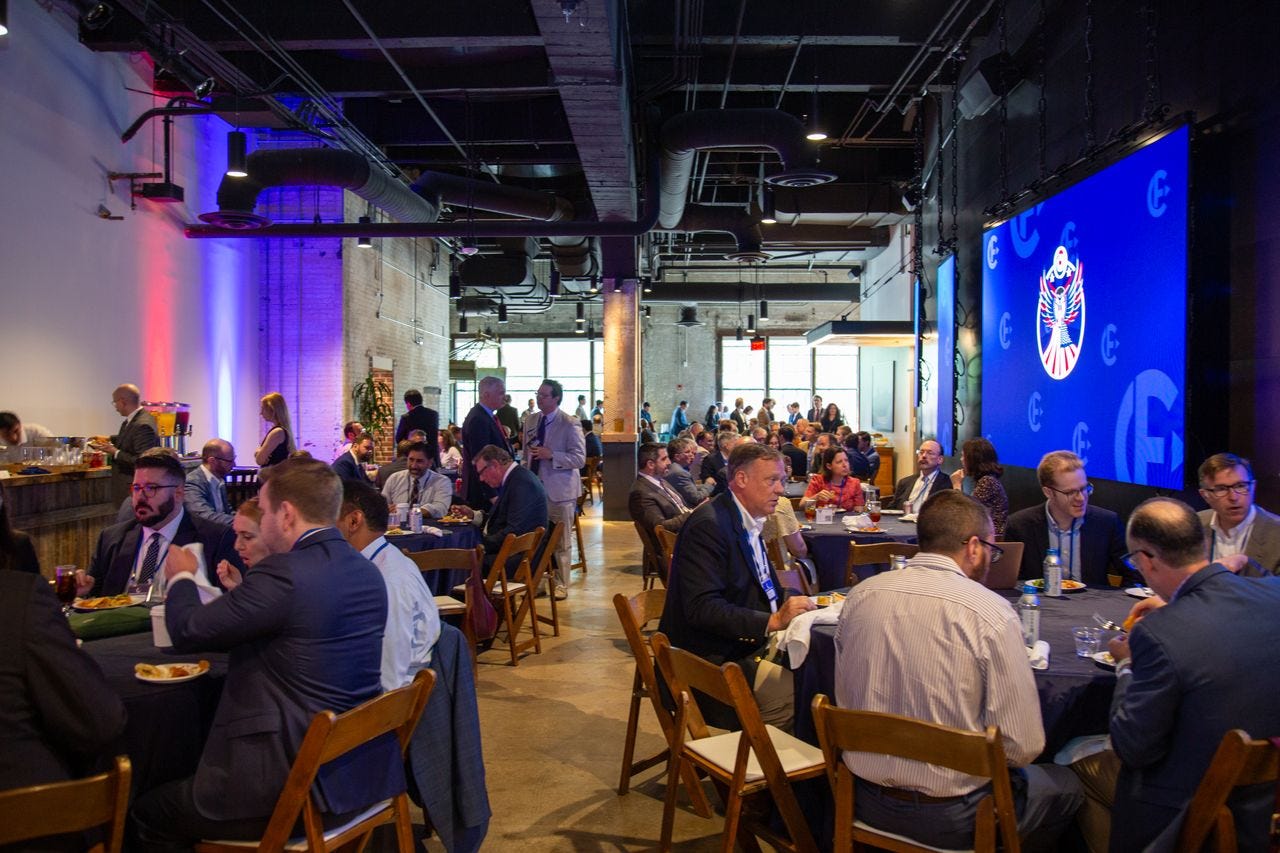
For the hundreds of Freedom Conservatives and allies who attended FreeCon 2026 last month in Washington, D.C., the daylong event offered welcome opportunities for inspiration, introspection, and collaboration.
Longtime leaders of American conservatism mingled with young activists, students, and interns. Think tank analysts and Capitol Hill staffers discussed legislative initiatives and policy reforms. Authors and journalists met new sources and jotted down new ideas. Donors and board members compared notes on best practices and brightest prospects.

“The FreeCon conference was great,” raved one nonprofit CEO. “Thank you so much for putting it on!”
Another participant, Justin Stapley, praised a FreeCon 2026 panel on the future of the American Right. “Absolutely love that when asked what fusionism is, the panel focuses on the way the Judeo-Christian moral tradition and the classically liberal tradition came together in a mutually supportive way at the American founding,” Stapley wrote.
“So true. Fusionism represents an understanding of the founding genius, not just a Cold War allyship.”
Today we feature more outtakes from and reactions to the 2026 Freedom Conservatism Conference.
Emerging coalition

Sam Raus is the David Boaz Resident Writing Fellow at Young Voices and a FreeCon signatory.
In a recent piece for Real Clear Markets, Raus wrote that the 2026 Freedom Conservatism Conference demonstrated that a “vibrant, diverse and youthful coalition of right-leaning voices is not ready to give up on market solutions and American liberty.”
Too many activists within the Populist Right are willing to trade “limited government and free-market capitalism” for “welfare and industrial policy,” he continued, which means “drifting toward the ideas of progressive Senator Elizabeth Warren or the state-directed model embraced by Viktor Orbán’s failed governing coalition in Hungary.”
Raus pointed to recent polls showing 80% of Republicans prefer candidates that keep the government out of business activity and that 89% want “economic regulation, when necessary, to be applied evenly rather than reward or punish businesses based on politics.”
“A narrow fringe of outspoken individuals seeks to politicize business, dictate markets and determine the future of free enterprise from bureaucratic offices on the Hill,” he concluded. “The majority of Americans do not agree — and Freedom Conservatism is offering them a movement to voice that perspective.”
With or without you
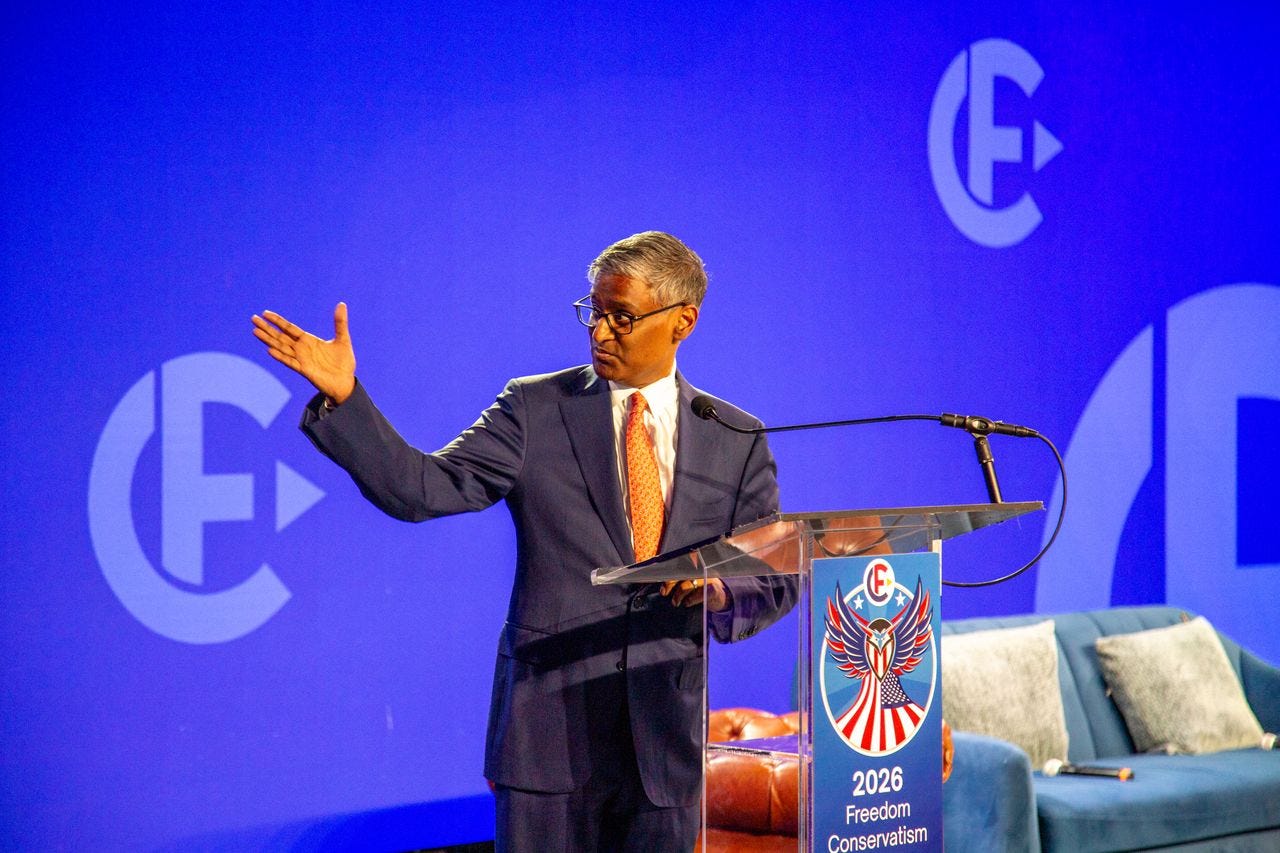
Ramesh Ponnuru is the editor of National Review, a columnist for The Washington Post, a senior fellow at the American Enterprise Institute, and a FreeCon signatory.
In a new cover piece for National Review based on his remarks to the 2026 Freedom Conservatism Conference, Ponnuru urged FreeCons to work with National Conservatives and other factions within the American Right on matters of mutual concern while rejecting the NatCons’ views on free enterprise and the rule of law.
“When we encounter NatCon arguments, proposals, and personalities, we need to sift through them, finding common ground where possible and identifying real points of disagreement and arguing them out,” he wrote.
FreeCons should also take seriously public concerns about family, culture, and assimilation, Ponnuru argued.
If FreeCons do so, if “we avoid the mistakes that I have mentioned while making the case for needed reforms as aggressively, creatively, and persistently as we can,” he concluded, “we will have done our part to repay the obligation we owe to Madison, Lincoln, and our other forebears.
“We will make it possible for Americans 50 years from now, on our 300th anniversary, to be still free, still secure, still prosperous — and, no doubt, still worried about the future of our country.”
Prep for victory
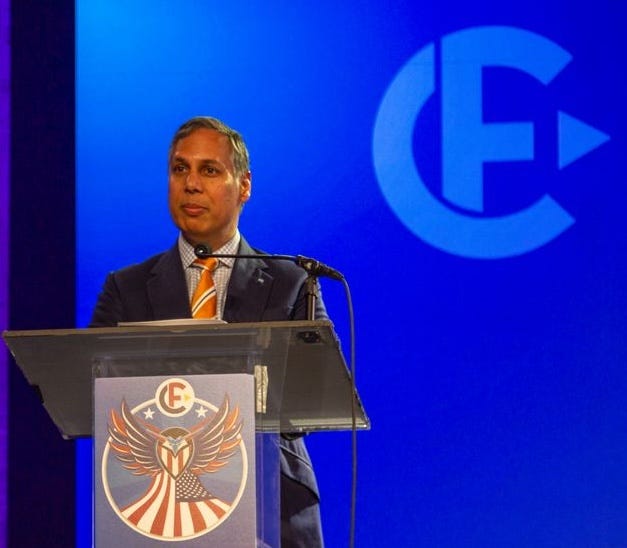
Avik Roy is co-founder and chairman of the Foundation for Research on Equal Opportunity (FREOPP) and one of the creators of the FreeCon project.
In a Real Clear Politics article adapted from his remarks at FreeCon 2026, Roy described the hundreds of conservative leaders, scholars, activists, and policy professionals who’ve signed the Freedom Conservatism Statement of Principles as “representing an incredible array of individuals and institutions all over America.”
“The entire business model of our post-liberal compatriots on either side of the aisle is to exclude a giant chunk of Americans from our shared enterprise,” he wrote. “They don’t believe it’s possible for all of us to achieve great things together; instead, they believe in ‘rewarding their friends and punishing their enemies.’
“We win by showing – and, ultimately, proving – that all Americans benefit from our values and our policies, even the ones who disagree with us, don’t look like us, don’t talk like us, or don’t vote like us.”
Roy concluded by observing that it is “time today to prepare for the victory that’s coming very soon, for the values that have made America great in the past and will make America great again in the future.”
In the mix
• At The Washington Post, FreeCon signatory John Cochrane argued that federal regulation of America’s financial markets has been “a mess for years” and that new Federal Reserve chairman Kevin Warsh should start straightening it out.
In the wake of the 2008 financial crisis, “leaders had the decency to admit that regulation failed and reforms were needed,” wrote Cochrane, a senior fellow at the Hoover Institution, and his colleague Amit Seru. “But the resulting changes — the Dodd-Frank law and the Fed’s subsidiary regulation — simply piled on the previous approach that focused on managing asset riskiness.”
“The Fed cannot rewrite Dodd-Frank by itself — only Congress can do that,” the authors concluded. “But the central bank can revise the subsidiary regulations and review its discretionary implementations. Periodically sunsetting and reviewing each rule would be a good start.”
• At The Wall Street Journal, FreeCon signatory Jack Butler mourned the death of Gordon S. Wood, the longtime Brown University historian who “loved America.”
Wood’s work helped make the American Revolution and its consequences “accessible to the public,” wrote Butler, deputy editor of the Journal’s “Free Expression” newsletter. “It also clarified how, in a philosophical sense, the inheritance of the founding was accessible to more than the direct posterity of the Founders.”
“Against ‘1619 Project’-style radicals, who view America as corrupt from its conception due to the original sin of slavery, Wood stressed that slavery was taken for granted around the world for millennia — ‘until the late 18th century and the American Revolution.’ And against ‘Heritage American’-style exclusionists, who would rate authentic Americanness by how long one’s family has been in the country, Wood argued that what makes America unique — and radical — is that ‘to be an American is not to be someone, but to believe in something.’”
“As America approaches its 250th anniversary, there are worrying signs that Americans are forgetting — or actively rejecting — what makes this nation great,” Butler concluded. “Gordon S. Wood did much to contest these baneful trends.”
• At National Review, FreeCon signatory Noah Rothman ridiculed a Guardian piece by by Thomas Piketty, Joseph Stiglitz, and four other left-wing economists claiming “growth” was a “doomed strategy.”
Their piece “was an exhibition in moral blackmail masquerading as an argument,” wrote Rothman, the author of the just-released Blood and Progress: A Century of Left-Wing Violence in America. “It made no attempt at persuasion. Rather, it was a fundraising pitch aimed at the already converted.”
“By the final paragraphs,” he continued, “the reader is wading hip-deep through a fetid cesspool of socialist buzzwords. The West must commit to ‘debt justice,’ which in practice leaves Western taxpayers on the hook for profligacy and mismanagement in the developing world. Another wealth transfer in the form of ‘reparative climate finance’ would also be nice. And this isn’t just sound economic policy, these ostensibly economic minds contend. It’s a ‘moral obligation rooted in the historical reality that many rich countries built their wealth by impoverishing the south.’”
“Are you ready to fly the red banners and storm the Winter Palace yet? No? Then perhaps you weren’t the intended audience for this one.”